
RFID Labels and Inlays Comprehensive Analysis of Core Differences
author: admin
2025-11-24
RFID Labels and Inlays Comprehensive Analysis of Core Differences
In the RFID (Radio Frequency Identification) technology system,nfc RFID label, wet inlay and dry inlay are the core carriers of identification functions. However, there are clear boundaries among the three in terms of structure, production process and application scenarios, and they are not concepts that can be replaced at will. Clarifying their differences is a basic prerequisite for the implementation of RFID projects.
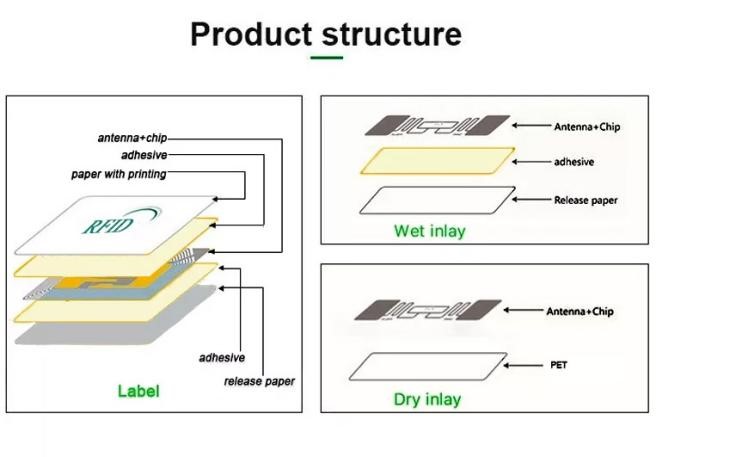
RFID Dry Inlay is the most basic form among the three, essentially an "electronic component composite" composed of an RFID chip, an antenna, and a substrate that carries both, without any adhesive layer or face stock. The antenna is usually attached to a high-temperature resistant substrate such as PET through etching, printing and other processes, and then bonded with the chip to form a complete circuit. Its core feature is "function first", retaining only the core components for radio frequency identification, and its appearance is mostly transparent or light-colored film. Due to its simple structure, the cost of dry inlay is relatively low, and it has high customization flexibility. It can be cut to size or adjust the antenna design according to needs, and is often used as a "semi-finished product" for further processing by downstream enterprises.
RFID Wet inlay is an extended processing product based on dry inlay, and the core difference lies in the addition of an "adhesive layer". During production, pressure-sensitive adhesive is evenly coated on the back of the dry inlay's substrate to form a three-layer structure of "substrate + chip antenna + adhesive layer". The "wet" here does not refer to a physically humid state, but comes from the fluidity characteristics of the adhesive layer in the gluing process. Wet inlay solves the problem that dry inlay is difficult to attach directly, and can be temporarily attached to the surface of objects, but it still lacks protection and identification functions and needs to be used with face stock. Its advantage is that it simplifies the subsequent label production process and is suitable for mass production scenarios.
RFID label is the most complete end product among the three, composed of wet inlay, face stock and release liner. The face stock can be made of coated paper, synthetic paper and other materials for printing visual content such as commodity information and barcodes; the release liner plays the role of carrying and protecting the adhesive layer, which can be peeled off during use. The label is die-cut into a fixed size, with the feature of "ready-to-stick", which combines the functions of radio frequency identification and information display. According to the application environment, the label can also be coated to improve water resistance and wear resistance, adapting to complex scenarios such as logistics and retail.
From the perspective of application logic, the three present a "progressive relationship": dry inlay is the basic component for wet inlay production; wet inlay is the intermediate carrier to support label processing; label is the end product that directly serves application scenarios. For example, if a logistics company needs to customize labels of special sizes, it may purchase dry inlays and apply glue by itself; while commodity labels in supermarkets are mostly produced as finished RFID labels by factories for immediate use.
Types of On metal RFID tags
What Can Damage an RFID Tag
Related Article

Against the backdrop of accelerated urbanization and a surge in motor vehicle ownership, traditional traffic management models face pain points such as low efficiency and difficult control. Specialized tags developed by RFID tag manufacturers for traffic scenarios, such as RFID License Plate Tag and UHF windshield tags, have been deeply integrated into the entire chain of vehicle control, parking management, and public transportation scheduling.
RFID Tags Powering Smart Traffic Management Upgrade
The global logistics sector is undergoing a transformative shift as RFID logistic labels emerge as the cornerstone of modern supply chain management. At the recently concluded Global Logistics Expo 2025, leading technology providers showcased cutting-edge RFID solutions designed to enhance traceability, reduce operational costs, and meet stringent compliance requirements across industries such as retail, healthcare, and food logistics.
RFID Logistic Labels Revolutionize Supply Chain Efficiency

In the era of Industry 4.0,RFID labels have emerged as a cornerstone of intelligent supply chain management, asset tracking, and consumer engagement. These compact devices, embedded with microchips and antennas, enable wireless data transmission, offering unparalleled efficiency compared to traditional barcodes. From retail to healthcare, RFID labels are revolutionizing operations across diverse sectors.
RFID Fin Tag Revolutionizes Retail Inventory Management

Relying on the advantages of batch identification of multiple tags and non-contact reading, RFID technology has realized the intelligent upgrading of the entire logistics link. Among them, the RFID UHF tags and RFID UHF tire tags developed by RFID tag manufacturers for logistics scenarios have solved the pain points of package management and transportation safety respectively, becoming a key support for smart logistics.
Application of RFID Tags in Express Logistics Industry