
The Role of RFID High-Frequency Tags in Library Management
author: admin
2025-03-07
The Role of RFID High-Frequency Tags in Library Management
With the rapid development of information technology, library management faces increasing challenges. Traditional book management methods can no longer meet the needs of modern libraries, especially in terms of improving efficiency, reducing errors, and enhancing user experience. RFID (Radio Frequency Identification) technology, as an advanced automatic identification technology, has been widely applied in the field of library management in recent years. This article will explore in detail the application and advantages of high-frequency RFID tags in library management.
Overview of RFID Technology
RFID technology is a non-contact automatic identification technology that uses radio waves. It mainly consists of three parts: RFID tags, RFID readers, and backend systems. The tag is the core of the RFID system, usually composed of a chip and an antenna, which can store and transmit data. The reader is responsible for reading the information from the tag and transmitting it to the backend system for processing. RFID technology can be divided into low frequency (LF), high frequency (HF), ultra-high frequency (UHF), and microwave frequency bands according to different operating frequencies. In library management, high-frequency (HF) RFID tags are widely used due to their shorter reading distance and higher data security.
Applications of High-Frequency RFID Tags in Library Management
1. Book Borrowing and Returning Management
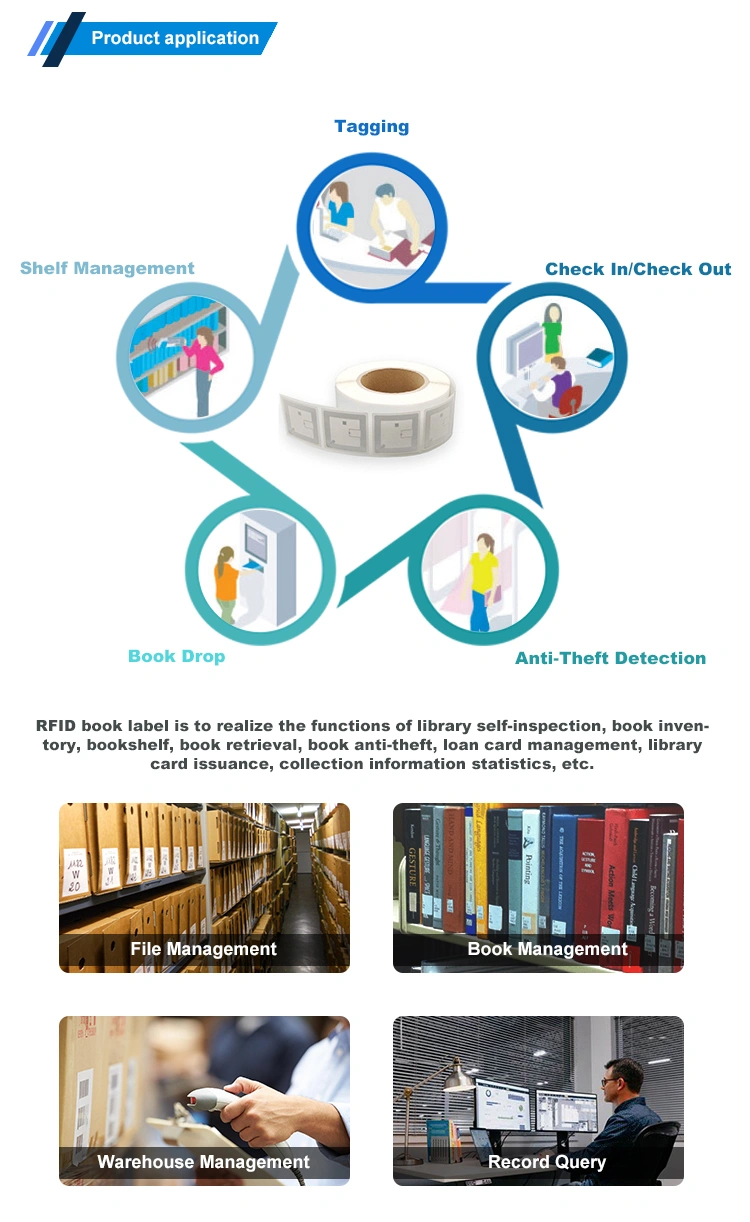
Traditional book borrowing and returning processes usually require manual scanning of barcodes, which is inefficient and prone to errors. The application of NFC library RFID tags can significantly improve the efficiency of borrowing and returning books. Readers only need to place the books near the RFID reader, and the system can automatically identify and complete the borrowing and returning operations. This not only reduces the waiting time for readers but also reduces the workload of staff.
2. Book Inventory
Book inventory is an important task in library management. The traditional method requires manual scanning of the barcode of each book, which is time-consuming and prone to omissions. The application of high-frequency RFID tags makes book inventory more efficient and accurate. Staff only need to move the handheld RFID reader between shelves, and the system can automatically identify and record the location and status of each book, greatly improving inventory efficiency.
3. Anti-Theft Management
Book theft in libraries is an important issue. NFC RFID tags can be integrated with the library's access control system to achieve automated anti-theft management. When readers carry unborrowed books through the access control, the system will automatically issue an alarm, reminding staff to check. This not only improves the anti-theft effect but also reduces interference with readers.
4. Book Location and Navigation
In large libraries, book location and navigation are complex issues. HF NFC RFID tags can be integrated with the library's navigation system to help readers quickly find the books they need. Readers only need to enter the book title or author in the system, and the system will display the exact location of the book and provide navigation routes, greatly improving the efficiency of readers' searches.
5. Data Statistics and Analysis
The application of RFID NFC library labels can also provide libraries with rich data statistics and analysis functions. The system can automatically record the number of borrowings, borrowing time, and other information of each book, helping library managers understand readers' reading habits and needs, thereby optimizing book procurement and layout strategies.
Advantages of High-Frequency RFID Tags
1.Efficiency
RFID NFC tags can achieve non-contact automatic identification, greatly improving the efficiency of library management. Whether it is borrowing and returning books, inventory, or anti-theft management, RFID technology can significantly reduce manual operations and improve work efficiency.
2. Accuracy
The reading accuracy of high-frequency RFID tags is much higher than that of traditional barcode technology. In book inventory and management, RFID technology can effectively reduce errors and omissions, improving management accuracy.
3. Security
RFID High-frequency tags have high data security, which can effectively prevent data from being tampered with or stolen. In book anti-theft management, RFID technology can monitor the flow of books in real-time, improving the anti-theft effect.
4. Convenience
The application of HF RFID tags provides great convenience for readers and managers. Readers can quickly complete borrowing and returning operations, and managers can easily conduct book inventory and data statistics, improving the overall user experience.
Conclusion
The application of high-frequency RFID tags in library management not only improves management efficiency and accuracy but also enhances anti-theft effects and user experience. With the continuous advancement of technology, RFID technology will play an increasingly important role in the field of library management, providing strong support for the modernization of library management.
Revolutionizing the Operating Room: How RFID Tags Are Enhancing Surgical Precision and Safety
RFID Tags: Revolutionizing Multiple Industries with Versatile Applications
Related Article

Against the backdrop of accelerated urbanization and a surge in motor vehicle ownership, traditional traffic management models face pain points such as low efficiency and difficult control. Specialized tags developed by RFID tag manufacturers for traffic scenarios, such as RFID License Plate Tag and UHF windshield tags, have been deeply integrated into the entire chain of vehicle control, parking management, and public transportation scheduling.
RFID Tags Powering Smart Traffic Management Upgrade
The global logistics sector is undergoing a transformative shift as RFID logistic labels emerge as the cornerstone of modern supply chain management. At the recently concluded Global Logistics Expo 2025, leading technology providers showcased cutting-edge RFID solutions designed to enhance traceability, reduce operational costs, and meet stringent compliance requirements across industries such as retail, healthcare, and food logistics.
RFID Logistic Labels Revolutionize Supply Chain Efficiency

In the era of Industry 4.0,RFID labels have emerged as a cornerstone of intelligent supply chain management, asset tracking, and consumer engagement. These compact devices, embedded with microchips and antennas, enable wireless data transmission, offering unparalleled efficiency compared to traditional barcodes. From retail to healthcare, RFID labels are revolutionizing operations across diverse sectors.
RFID Fin Tag Revolutionizes Retail Inventory Management

Relying on the advantages of batch identification of multiple tags and non-contact reading, RFID technology has realized the intelligent upgrading of the entire logistics link. Among them, the RFID UHF tags and RFID UHF tire tags developed by RFID tag manufacturers for logistics scenarios have solved the pain points of package management and transportation safety respectively, becoming a key support for smart logistics.
Application of RFID Tags in Express Logistics Industry